
Meeting my shame on the piste
2025
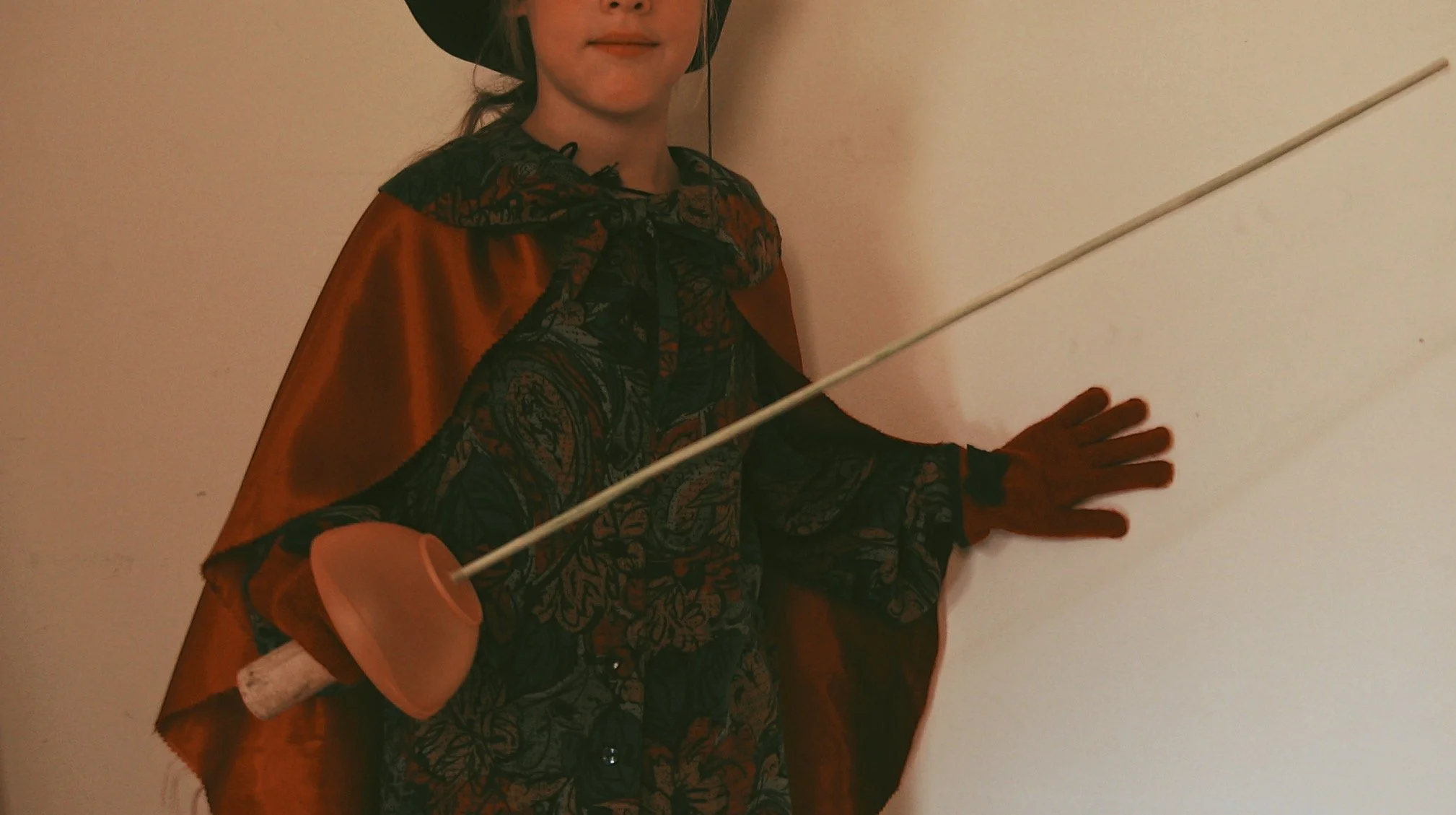
The very first “serious book” I ever read was Dumas’ The Three Musketeers. I was eight, and after I was done with it, I requested my mum to make me a cape and a rag doll of D’Artanjan. My dad was then forced to make me a rapier, and he did so out of a twig, a wine cork and a bright orange plastic dessert bowl. For reasons not fully known to me, there are quite a few gaps in my childhood memories, but my dad handing me the rapier he made is one of the most vivid ones I have retained. I did not let go of it for weeks, and I think at that point my parents knew me well enough to see that there wasn’t much use in parroting that this was not socially appropriate everyday attire. The Three Musketeers is also the only novel I have ever actively dreamt about. I don’t remember now what exactly occurred in these dreams, but I remember meeting the four main characters and becoming a part of their group. As it often happens in dreams, I was much older in them than I was in real life. I also was not disabled and could keep up with the fighting.
It doesn’t take a degree in human psychology to understand the reasons why I was so deeply drawn to a story like this at that age. I wanted to be included and accepted, to have a group of friends to go on imaginary adventures with, I wished to posess the ability to stand up for myself and to feel like I hold some power against the bad guys. I had just started school and, never having gone to preschool, was now living through my very first real experience of the wickedness and cruelty of human children outside of literature. Even though I did attend a school that had separate programmes for kids with specialised needs, I was never part of one and was the only kid with a physical disability in my year. My mum, no doubt wishing to make my life easier and to save me from feeling inadequate, made me wear long skirts so “people would stare at my ugly bits less” and pulled me out of PE classes so I wouldn’t have to feel less than my classmates. The first made me angry. I think even as a kid, I realised that there is something deeply messed up about having to hide some parts of oneself in order to gain love and acceptance. My feelings on the latter are more divided. I am not sure what the right decision would have been, especially at such a young age. I don’t remember what I thought about it when it happened. What I do recall pretty vividly is that getting “special treatment” in this way only made the bullying and the snarky comments from my classmates worse. “Hey, why aren’t you coming to PE again?” was the loudest question in the girls locker room when everyone was grabbing their gym bags and I came in to get my coat so I could sneak away to the corner store for a bar of chocolate. I never knew what to say or how to say it in a way that would carry any real weight, so I stayed quiet. They all knew the answer; they just wanted the satisfaction of hearing me admit that I was somehow defective, and I had decided not to give it to them. I sometimes think about what could have happened if pulling me out of these classes would not have been an option. If I had to participate no matter what, if I had to lay all of myself bare and completely embarrass myself in front of my catty classmates. Maybe even potentially hurt myself in the process. Would it truly have mattered as much as I thought? Would everyone stop and stare and laugh, and would the sound of it reverberate through my bones and paralyse me and haunt me for the rest of my days? Maybe. Or, would they all just be so engrossed in their own pursuits of achieving physical excellence that they would barely notice someone who was really bad at everything but tried to do it anyway?
I believe that this experience was the first of many that made me think that in this life things need to be done perfectly or not at all. If you cannot do something flawlessly, you sit it out on the sidelines and let others have a go – the kids that are better and stronger and more talented than you. Already coming from a family of intellectuals with crippling tendencies of perfectionism, this was not a foreign concept to me and it stuck before I realised it. I began to deny myself the experiences within which there was even the slightest chance that my body could end up embarrassing me. School plays, musicals and anything to do with being on my feet in the spotlight, especially if it involved performing with other people. It ripped my heart out. I wanted to do theatre, and I wanted to sing and to dance and to be in front of an audience, but I couldn’t handle the thought of messing up on such a scale, of ruining the hard work of others and of attracting attention to my strange body when it could have been spent on something much more worthwhile. Around this time I also began to experience increased muscle spasms that appeared whenever I was nervous, which meant that, if I had to speak in front of the class, for example, the first thought in my head would never be. “What am I going to say?” Instead it was, “Where do I hold on to so I can keep upright? Is there a corner of a desk? Would it be too strange to ask for a chair? Would the spasms get so bad my knees will start to shake, and if so, can I stand behind anything so they can’t see it?” Simply existing in an academic setting became an endless shift at the anticipatory threat factory that I could never clock out of. What kept me going was the one thing that has haunted every former gifted kid since the beginning of time – the need for academic validation. In my head, my faults and strong suits were laid on a scale, and my life was a balancing act. If I just did well enough at absolutely everything else ever, it could balance out my deficiencies, and if I just got the math right, it would finally make me feel equal to other people. And so, every public performance that I could not get out of became an overcompensation. I needed to speak so well that my audience had no choice but to focus on my story more than on the malfunctioning machinery that was sent to deliver it. If I go above and beyond, maybe they won’t even notice my knees shaking. Before I caught onto this happening, I had unconsciously trained myself to constantly observe myself through the eyes of other people, no matter what I did or where I was. I had become my own voyeur, and I could not close the blinds anymore. I did not understand why every social interaction exhausted me so greatly, but I know now that it was because I was always performing. This is something I am still working on undoing. By then, my body was something that I believed was holding me back from experiencing life the way it should be lived. I know now it was not my body standing between me and the life that I desired; it was me and my shame. The fear of embarrassment and judgement. But that is not how I saw it then. And so began the split into two that I would spend the rest of my life repairing. My body, the one that embarrasses me, the one that my mother always told me should be hidden for my own good. And my mind, the one that tries to hold it all together and deals with the aftermath. My soul was left to bleed out somewhere in the cold, empty space between the two.
The larger consequences of such a split in my later life could make up a dozen separate essays on their own, so I will not touch upon them this time. What began the painstakingly slow healing process, though, as silly as it sounds, was making the decision to begin going to the gym consistently a few years ago. Exposing myself to difficulty, at the pace I could handle, on my own and with a trainer made me see my body and the things it was capable of in a completely different light. However, even if it was healing the psychological split between my body and mind, my sense of shame still persisted. I did not know quite how to begin to take it down; however, I knew that the battle with it would be a lot less simple and far more taxing.
The answer to this came about unexpectedly a few months ago. In fact, when I found it, I did not quite realise what exactly it was. I met a fencing instructor, and just a few minutes into our first meeting, as we were both admiring rapiers at the Fitzwilliam Museum, I ended up mentioning the first serious book I read as an eight-year-old. It turned into a longer conversation, and by the end of it I summoned the courage to ask if he thought I could be capable of fencing. He answered, saying he doesn’t see why not and that I should give it a go. It hit me then at that moment how badly I had needed someone to tell me something similar when I was eight. Instead of protecting me and pulling me out of harm’s way whenever embarrassment loomed around the corner, I needed someone to say, “Give it a go anyway.” Give it a go anyway. It will not kill you unless you give it power to. Yes, my body is different. Yes, there is a lot I cannot do in the same way as able-bodied people can. I do not possess the same sort of grace in the way I move. I would be lying if I said I didn’t care about these things or that I have never wished they were different, but this is how it is. This is how it is, and I will give it a go anyway.
My first session at the Cambridge University Fencing Club felt more like the most intense form of therapy ever invented than a sport. Under the fluorescent lighting, surrounded by about thirty students, a good chunk of whom had been part of different sports clubs for years, I found myself fighting with my mind and my emotions a lot more than I did with my startled body. My brain was working a million miles a minute. Never in my life had I felt more out of place. Most of the warm-up exercises I stumbled through the best I could, pushing myself to do it in the ways I knew how, even if it looked nothing like the blueprint. There also were some that I was completely incapable of doing and needed to sit out on the sidelines. I could feel the eyes on me, and so I talked to my inner kid constantly in my head. That eight-year-old was still in there, and she was both more excited than ever and utterly terrified. She told me she wants to do this as perfectly as D’Artagnan would, and I had to hold her face in my hands and say that I am very sorry, but we cannot. It made her sad for a minute, but then she saw a rapier. A real one this time, not one made out of twigs and wine corks. I told her that our failures don’t mean anything as long as we try. That she is still worthy. That she can do it anyway, that she can do it badly and it still counts. She wasn’t listening at that point anymore; she was just excited to hold a sword.
And I was right there with her. I was so emotionally and physically exhausted by the end of the first half of the session that getting some air in my lungs felt like a lot of effort. However, the moment our tutor finally asked us to suit up and I could actually put the mask on and pick up the blade, I felt a surge of power unlike anything I have experienced before. It has become the reason why I go back even as things have advanced and become more and more difficult. The source of this power could be the anonymity that the mask provided, or the presence of a deadly weapon in my hand, or the realisation I am honouring a secret, little dream I had more than twenty years ago, but no matter what it was, I was basking in it. I was pretty sure my opponent saw me making mistakes and executing my lunges with a form that was far from textbook, but I really didn’t care, even when I was losing points over and over again. There were moments when I won some as well. It was not all terrible, and there were things I did fairly well. I tried to hold onto them. My reflexes with the blade were good. I was a whole lot better at attacking and stepping forward than I was at defence and stepping back. As long as I could keep the shame out, I could keep going.
As the sessions progressed, things got harder. I found myself at war with my ego and what was physically possible for me. I wanted to be good; I wanted to do this like everyone else. I could not. I could not, and I needed to find a way to be okay with that, to remember why I was here in the first place. Excellence was never an option, but it was also never the goal. That was not why I started to do this. The goal was to meet my own shame on the piste as an eight-year-old and to find a way to win.
And I did. I went to the studio week after week, when every bone in my body told me it would be so much easier to just stay at home. If I hid away, I wouldn’t have to commute for an hour and a half in the rain. I wouldn’t have to come face to face with the fact that I cannot jump with one leg in the air or jump three steps backward within a second interval, or that running across the room makes me feel like I could fall and bash my head in any second, or that people asking me if I am okay is a very difficult question to answer. I wouldn’t have to face the fact that during every session, there was at least one moment where I caught myself feeling very small compared to everyone else. But none of it really mattered. The only thing that held any weight was that I felt all this and I did it anyway. I stood in front of this beast, I let my mask fall, I gripped the handle of my sword and I attacked. It was lousy, and it was not perfect, and yet I did it anyway. Over and over and over again.
I have come back, just minutes before writing this, from my last session of this term. The points have been counted and the verdict is this – I believe that there will always be a part of me that will wonder what it would have been like if I was born like everyone else. I wish I could wrap this up with a pretty bow and say now with full confidence that this has utterly transformed me and taught me to love all of myself unconditionally and that I would never wish for things to be different again. There will always be a part of me that will wonder how my life, my character and my experiences could have looked and felt like if it were not for cerebral palsy. Don’t judge me too harshly for this, dear reader. I think it’s pretty human to ponder upon such things every once in a while. However, I never let these musings steal more than a few seconds of my time. After all, I am here, in this place, in this body that I have been given, either by God or some other higher power. None of this is an accident. This body is mine, and it is capable of so much more than I gave it credit for just a few months ago. It has carried me through this life brilliantly so far, and I make a conscious choice to be grateful for it every day.
I would be lying if I said that shame and embarrassment have completely ceased to darken my doorway. I know them well; I have fenced them both week after week. But sometimes they sneak up on me still, when I am alone and there is no one around. When I have no sword and the rules that would be enforced on the piste do not apply. When they knock, I welcome them, yet when they cross my threshold now, they know they hold no power in this house anymore. I have won one too many times. They cannot touch me now. Because I have built this place of refuge with my bare hands, despite their best efforts to tear it down. And now they have come to bask in the light of the hearth I have lit. I ask them to sit next to it, I pour us tea, and we read The Three Musketeers together. Then, as the fire blazes higher and higher, I wait. I wait, and I watch them dry out and turn to dust on my living room carpet.
Leadership
2022
It has been very hard to focus on anything else besides the events in Ukraine these past few days. Just going to work, doing everyday chores feels so wrong to me, and yet somehow life has not stopped for us. I am in my thoughts with the people of Ukraine, constantly. I am praying as I never have before. I am feeling emotions I never thought I would. I am standing on my street, the sunshine washing over me from a clear, blue sky and I am so grateful, so grateful to be alive, to be safe, to have my family next to me, to go to sleep knowing my brother won’t be called to join the forces in the morning. I am grateful to have only heard the blaring of sirens when they test them. I am grateful to fall asleep in my bed instead of a metro station. To wake up and have breakfast knowing I’ll have dinner too. To know that my home will still be there for me to come back to in the evening. I will never, ever again take any of these things for granted.
I come home, I turn on the news, I see Zelenskyy talking to his people. Telling Americans he doesn’t need a ride. He’s still in Kyiv and he’s not going anywhere. Russian convoys falling, government websites hacked. Ukrainian spirit unwavering. I turn on the news and after two sleepless nights I see hope. I see hope and bravery and suddenly it feels like the world has shifted completely and I will never see it the same way again. And I love people. I have never felt such overwhelming love for people before. It seems like the Ukrainian spirit and the brave protestors out on the streets of Moscow and St. Petersburg has made me see human beings in a completely new light. How strong, how brave, how resilient, how united and how incredible we are capable of being. After 25 years on this earth it hits me that heroes are not only found in books. They are here. They live among us, they live and breathe and they fight. They tell Russian warships to go to hell. No evil will ever prevail in the the presence of such force, of such light and such pure desire to protect what's sacred. Ukrainians, you are incredible. You are a force of nature. You have changed something in us all. Glory to Ukraine, its president and its people. And to the brave Russian citizens out on the streets standing up against Putin's war.
Latvia stands with you.
Слава Україні.

Personal mythologies
2021
As I gulped down my sixth cup of Earl Grey that I had made way stronger than I originally intended to yesterday evening, I thought about people’s mythologies. The stories we tell about ourselves, to ourselves, to justify certain behaviours and actions we go through at different periods in our lovely but overly complicated lives. Since I cannot walk in my parents’, friends’ or lovers’ shoes (though I find there is something extremely fascinating and frustrating about trying to do that – which I try to, whenever I can, through conversation), I can walk in mine. What is my own personal mythology, right now, on the first day of 2021?
In fact, now I don’t have one. Technically, I still do, but I am rewriting it now; I have been since the beginning of 2020, and I am nowhere near done. I’m going through all of it, pen clutched between shaky fingers, dripping red ink all over what seemed to be the most convincing manuscript I had ever written just a little more than three years ago. It’s embarrassing, and it makes no sense, but it’s so well written that I managed to convince myself that that’s me and that will always be me. Just because I said so, at some point. It’s outdated, and I want to rip it up.
My old mythology starts with a good old-fashioned high-school heartbreak – the time in my life where I absolutely refused to accept the fact that people are allowed to not fit together when I want them to. The audacity, right? How I came to believe something like this at the age of 18 would be a whole other essay that I might get into another time. The point was – if it didn’t fit, I was stupidly determined to make it fit. I’ll jam the pieces together. If I just work hard enough, if I do enough, if I just try more, that will work; he’ll see me. And when he didn’t, I didn’t want the truth. At that point I wouldn’t hear it even if somebody was screaming it into my ear. I needed to tell myself something that would make sense in my own narrative – he didn’t return my feelings because, duh, I wasn’t trying hard enough. We couldn’t have a conversation that lasted for more than 10 minutes because, duh, I was boring. I was too quiet; I didn’t have the right questions to ask, I had no social skills, my life was boring, and I was as interesting as a piece of toast. It wasn’t him and his lack of social skills; it wasn’t that he just didn’t turn out to be the person for me. It was all me; I was messing it up just by being the boring old me. Here she goes, the boring Anna who can’t have a conversation. Nobody else was telling me that. I was telling that to myself. Every day, over and over again. And eventually I convinced myself of this story, more than anyone else ever could. No compliments on my writing, my work or my art could change that – that was just a sound to me, white noise. That had become my mythology, the legend of who I was. Oh, they’re probably just saying those nice things because they pity me. They just feel bad; they just need something from me. It’s not about who I am or what I can do. Because how could they mean that sincerely? I am the boring one; there’s nothing interesting about me. Oh, you want me to talk about myself? No, you don’t. Let’s just change the topic to what you are interested in, that’s better for everyone. Better yet, if you’re willing to open up, please just let me be your free therapist for a few hours because that’s the only way I feel useful to anyone as a human being.
When I thought rationally, I knew that what I was doing and what I was telling myself was bullshit with no grounds to it. I reposted a whole bunch of Instagram stories of inspirational quotes that I wish I could follow and then realised I couldn’t. The fact that we are capable of grasping a concept with our rational mind doesn’t mean that our heart follows – if that were the case, there would be no toxic relationships or family dynamics, no substance abuse and no crime. The fact that we understand something doesn’t mean absolutely anything if we don’t feel it on the inside first.
Our rational mind can help us to look for an exit route, though – I managed to pull myself out of my narrative professionally when I started publishing my art online and working as a designer. I felt like finally somebody needed me and the things I do, and that was powerful, but not enough. Things started to take off in my career, but it all came crashing down again when it came to friendships and romantic relationships – because that’s where we can’t rationalise things so easily anymore, and I found myself drowning again. I wouldn’t text back close friends for the simple reason that I kept telling myself – they don’t actually want to talk to you; they’re just doing that to be polite. So if you don’t answer, you’re actually doing them a favour, and they can use their time more wisely. Now that sounds kind of crazy, right? It is. I still feel like that occasionally, but now I can tell myself that my mind is playing tricks on me. But back then I had no idea what it was. I was just “tired and introverted” on most days. In the middle of 2019 I briefly dated an individual who had the intellectual capacity of a teaspoon just because I felt like that’s the best that I could do as a “boring and uninteresting woman”. I knew I could do better, but I didn’t feel like I could. That’s the thing about life: we never actually want what’s good for us; we just want to be right in whatever messed-up story we are telling ourselves. When the relationship came to an end (as I knew it would from day one, because I just needed to be right about the fact that I’m boring and nobody actually likes me), I stood up for myself and my worth for the first time in a long time. Because as a blessing in disguise throughout our incredibly dry conversations, which I was trying to keep alive with the dedication of an old salmon fighting currents in November, I realised – actually, he’s the boring one. It was never me. I, in fact, kind of have a lot to say; he’s just totally not getting it. It was another emotional earthquake, just strong enough to kickstart a new chapter. And now I knew what I didn’t want to happen again; I started to realise that, in fact, I do deserve to have someone better than a man who never reads or goes to art galleries and has the kissing skills of a washing machine. And for that heart-level realisation, I remain forever grateful to him.
A chance to study in England at the beginning of 2020 basically served me a chance to reinvent myself on a silver platter. And I seized it with both hands. It remains my most beautiful experience of the year because I was actively rewriting my mythology and doing my best to show up as the woman I wanted to be and not who I thought I was before.
All these pretty words don’t mean that I never step on the shards of my past self anymore. I do. When my boyfriend doesn’t text me back for a long time, I panic, because there is an echo in my head that still likes to yell that I’m boring and that’s why he doesn’t want to talk. Or that I’ve said something wrong and need to come up with a seven-page explanation of why I used the exact words I did. I have an intense fear of someday running out of things to say, so I have a tendency to keep some of my most important stories to myself, not because I wouldn’t trust the ones I love, but as a guarantee that I have something to “pull out of the bag” if it gets really quiet one day. Silence still scares the hell out of me. But when there is a silent moment in a conversation, I talk to myself as a mother would to a little child. I tell myself gently that that’s a normal thing; the world, in fact, is not collapsing, and it says nothing about how the other person feels about me. I still feel uncomfortable, but I don’t blame myself for the silence occurring anymore. The pieces of what I believed in are still hiding in between the floorboards, and sometimes they’re so tiny that I can’t pick them up to examine them properly. I can simply feel them cutting my feet as I walk over them. But I just let them be. I’m the one who’s walking over it, after all. Those are all just scratches. I’ll pour the blood that’s dripping from my feet into a fountain pen and write another damn page in my book.
Performative empathy and cake metaphors
2021
I think about every 5th post I've come across on my Instagram feed these past few days has been about the situation in Palestine. When that hadn’t come to the attention of the mainstream Western public yet, it was Black Lives Matter, the Capitol Raid, people willing to verbally murder Candice Owens for commenting on Harry Styles’ outfit for a high-fashion shoot (girl, dudes wore tights 200 years ago and were perfectly manly; get over yourself), the devastating Covid-19 situation in India with bodies burnt in parking lots due to the overload in crematoriums, oxygen sold on the Black Market and the individuals who claimed it all to be a media hoax. And everyone had an opinion about it. No matter how foreign the culture, the scene, or the event – everyone had something to say. And if you don’t speak up (aka, usually “speaking up on an issue” now means (re)posting an Instagram story, a Facebook post or a tweet with a comment on it), you are “ignorant” and “selfish” and “a privileged (white) person who can’t count their blessings”. The tragic thing here is – somewhere along the way we have started to call under-educated commenting on contemporary issues “raising awareness”. We have hit a point where saying something at all and putting a hashtag on it seems to matter more to us as individuals than actually caring about the issue itself and taking our time to study it deeply. Appearing like you care has become more important than actually paying attention. I know this because I too have been there. I’ll never forget a moment when I reposted an article about a Black kid being shot by the police for carrying a toy gun and commenting something along the lines of “is this what people pay taxes for in the US?” on it. My very first emotion was anger for a child killed (obviously, because I'm not a psychopath), and my very first thought was, “The policeman must be racist.” But is he? He’s definitely a murderer, no doubt. But is he racist? Was the kid innocent? I did not know then. And I did not pay enough attention to find out because I thought I knew anyway. I thought I knew because I saw words like “white policeman” and “Afro-American child”. In my brain that was enough information to tell good from evil. And that way of thinking is like cancer; it only gets worse. You don’t know until you look closely. Don’t ever tell yourself you do. That time a friend of mine called me out on my comment and sent me a whole bunch of articles about the shooting statistics in America, the role high-crime neighbourhoods play in all of the data we are presented with at the end of the day and how even the most insane things can correlate with each other – it doesn’t mean that there is always an actual connection. The number of people who have drowned in a pool from 1999-2009 in the US correlates perfectly with the number of films Nicolas Cage appeared in. The people who drowned after falling off of a fishing boat correlate with the marriage rate in Kentucky.
For a generation that claims to hate any sort of labels, we sure love to put things in neat boxes. A person of colour is shot? It’s automatically a racially motivated hate crime. No background check or further learning about the event is necessary. An LGBTQIA+ individual is being cursed at? Homophobic intent; no other explanation is necessary. But people are so much more than what we (still) label them as. We are not used to saying it in today’s society, but a person can be in a wheelchair AND be an arsehole. A person can be a person of colour AND be rude. A person can be gay AND be intolerant. These things are not mutually exclusive. However, the emphasis must always stay on the “can be”. It should never turn into the statement “is”. Check your crime scene with your gloves on and don’t make assumptions.
I am not “Anna, the disabled girl”. I am disabled, but I would never lead with that. I am a woman, an illustrator, a graphic designer, a wannabe writer, a reader, a student, a lover, and a fighter. And then disabled too. I am proud to be who I am fully, and I would never let anyone make me feel ashamed of any parts of me anymore. But I would also never make only one part of me my whole identity slogan. People sometimes interpret me not speaking up about my disability or not drawing attention to it on my social media as me “being ashamed of it”. And that’s not true at all; I simply believe there are things about me that deserve more attention than the condition I was born with. If we build a society where you are “first and foremost *insert a minority/social/political group*” and then hide all of your other traits in the shadows to appear more relatable or feel more included, then we are headed down a dangerous road. I can understand the temptation to do this and I would never judge anyone who does, though – human beings have been hardwired to look for a tribe since the beginning of time. It was simply a survival mechanism – without a community to rely on, our ancestors died. Our need for social inclusion is the biggest drive there is. We are pack animals, and that will never change – we need to feel included. The easiest way to do this is to put a neat label on yourself and call yourself “part of this group”. That creates a pretty illusion of a family and a home. But is that the right way to do this? We are often blind to the things our family does wrong because, first and foremost, we love them. They make us feel safe and accepted. And we don't want to see the bad in people like that. The faux idea of a family blinds us and keeps us from making clear-headed, individual judgements because we don't want to turn against our tribe. Our ancient brain says that this is when we die. But it's 2021 now, and that's not the reality anymore.
The society's focus on performative inclusivity has impacted the entertainment scene most noticeably. Now we have awards denied for movies with great writing, acting and plotlines just because they didn’t include enough POC, trans or LGBTQIA+ characters. What have we achieved this way? Let’s get one thing straight here – do we want more diverse representation in movies? Absolutely we do. I would have been so happy to see more characters on screen that looked like me when I was growing up. It would have helped me so much with my self-esteem and image issues that I struggled with for so long. And it didn’t exist for me, and that makes me sad. However, would I have wanted to see a disabled character for the sake of the movie having a disabled character? No. I would want her to be someone with depth and interests and so much more besides the way she looks and moves. I would want her to be written beautifully and her struggles to be portrayed realistically. That's empowering. I wouldn’t want her to just be there for the brownie points. Imagine if people started doing that in real life – “I’m going to ask my friend Kyle to go to the party with me because he’s gay, and that will let other people know I’m not homophobic”. So, is Kyle as low in your eyes as your designer purse that helps you carry your lipstick and wallet and lets others know you're not poor? Doesn’t sound too inclusive to me. But it happens way too often – just so the director can call their movie inclusive when, in fact, there is nothing substantially inclusive about it under the surface. When we take awards away from deserving movies for “lack of representation” and give it to those that take stories of diverse, deep individuals and degrade them down to the “funny black sidekick/gay best friend” trope without any real care for the community at all, we are normalising and funding the “accessory minority” movie shelf, instead of making people feel seen. Even if the minority character has the main role, it can still be badly written and half-baked – the same way a white dude character can. A minority character appearing on screen doesn’t automatically mean the movie is revolutionary or better than anything else made before – it’s how deep the production team digs into their stories and how thoroughly they wish to understand the character's struggles that truly matters. Even if the character is white. Or a man. Or, *gasp*, a white man. It’s the digging that matters. Look at the writing. And after that – at the inclusivity. Not the other way around. We want more representation, but not just for the sake of it. I’d eat a cake that’s made out of quality ingredients by a talented chef, even if the icing wasn’t too flashy – because that’s not what the freaking cake is about.
Sunlight
2017
„It’s on Friday. I’m catching the plane at 12:50.”
You sat next to the old piano, hands shoved in your pockets. I didn’t say anything; I didn’t move either, as if any kind of action would make this simple, inevitable fact more real. In fact, if I hadn’t heard the words that just left your lips so nonchalantly, I would be certain that what lay before my eyes was the most peaceful sight I had ever seen. The evening sunlight peeked into the room through the half-closed shutters and stopped to rest on your shoulder. You didn’t look at me. Maybe you were scared of finding proof of what you had feared in my gaze. But maybe I was flattering myself, and in reality you simply didn’t care at all. You threw your head back and sighed, closing your eyes. I studied your profile carefully, tracing every curve, the way your dark hair fell on your forehead, still damp from the evening run you just came back from, the bridge of your nose, the cupid’s bow, the curve of your lips, slightly parted, your chin, jawline, the beads of sweat on your neck, Adam’s apple, and the rim of the old hoodie you had been wearing for years now and never listened to me when I said you needed a new one. I was jealous of the sunlight now, resting on your neck and touching you in ways I never could. The sight of you had now been burnt in my mind even though I knew you wouldn’t want it so. There are some things one just can’t help. You were at the back of my mind whenever I saw someone eating French fries without ketchup; you were in the songs of street musicians, broken street lights and forget-me-nots; you were at my wandering fingertips at 3 am on lonely nights. And I really hated myself for that. Now the essence of you will be locked in sunsets too. I knew your hands were in your pockets because of me. It looked uncomfortable, and you never liked sitting still anyway. There was a piano in front of you. If I had not entered the room, your slender fingers would slide over the keys; that’s where they loved to be. And then the sunlight would not be the only thing I’d be jealous of. But you knew I had been drinking. And you knew that I’m only brave and stupid enough to hold your hand with alcohol running through my veins. „Don’t try anything funny”. That’s what you were trying to say, hands in your pockets; I knew. I missed your touch like crazy nonetheless, both drunk and sober. But you were right; if I tried that again, I wouldn’t let you leave. „Promise me you’ll buy a new hoodie, ok? And you need a haircut,” I finally said, faintly.
You smiled, eyes still closed. Dear God, I wish you hadn’t. My heart sank down into my stomach.
„Will you see me off?”
I clutched the bottle of vodka I still had in my hand to stop myself from screaming. You were cruel. That was nothing new. But you had no idea.
„No.”
You finally looked at me. And I tried my best not to get lost in you, as always. Your gaze warmed me more than any sunlight ever could, and I hated myself for that too. You didn’t lower your stare; I knew you were studying me. You bit your lip, and I looked away in an instant, gulping down another shot, hoping to swallow my tears along with the alcohol. You smiled, and I felt your gaze at the back of my neck. I knew you had figured it out. And it wouldn't change a thing.